
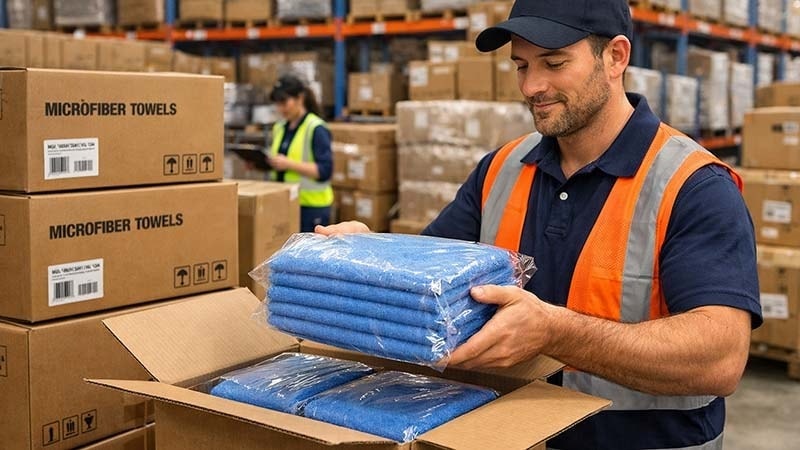
Microfiber towels are widely used across industries like hospitality, healthcare, automotive, and more. However, quality inconsistencies and inefficient cleaning performance have led to frequent replacements.
But using high-quality microfiber towels can significantly reduce a business’s operational costs. These towels last longer than cotton ones and therefore need fewer replacements.
In this article, we teach you everything B2B buyers need to know before buying towels for their business.
Learn about microfiber structure, key quality indicators, industry certifications, and procurement strategies.
Understanding Microfiber Towels at a Technical Level
Before purchasing, it’s important to discuss microfiber towels at a technical level. The following factors determine the overall construction and quality of microfiber towels.
Split Fiber Design
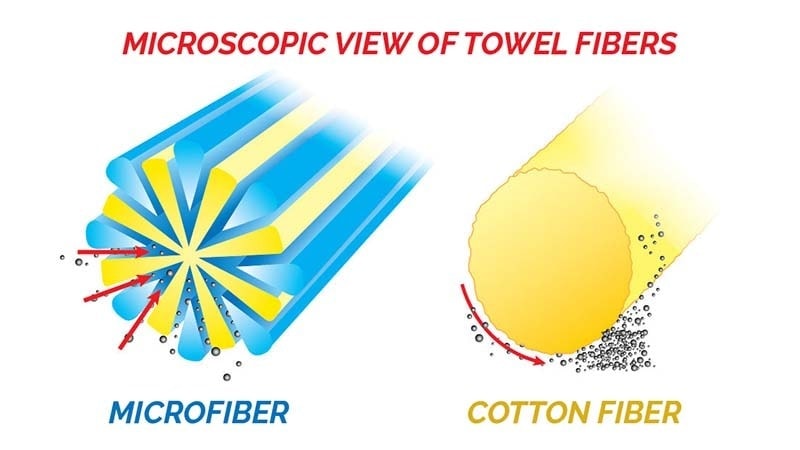
Microfibers are made from ultra-fine synthetic fibers (much smaller than a human hair). They have a unique split fiber design.
Fibers with higher split density improve cleaning efficiency and reduce cleaning chemical use. The ultra-fine fibers create static charges that attract dust particles and hold onto them. Similarly, the gap between the fibers holds onto the soap and reduces waste.
Hence, microfibers are preferred in commercial settings, like hospitals and resorts. They use fewer chemicals and soap to clean and sanitize a surface. Microfiber towels are also great for sanitizing stainless steel surfaces in commercial kitchens.
Fiber Blend Ratios
Microfiber towels are made from a mix (or blend) of polyester and polyamide (nylon). The most common blend ratio is 80/20. This means 80% polyester and 20% polyamide. Anything below 20% is considered lower quality.
Premium towels with a 70/30 blend have a plush texture and are long-lasting. Hence, they are widely used in the hospitality, healthcare, and automatic care industries.
A 70/30 towel has a higher initial cost. But they are more durable, so you are less likely to replace them. Therefore, 70/30 towels end up costing less over time.
Fabric GSM
GSM or grams per square meter is a metric used to define the weight of a textile. Higher GSM means more material is present in the microfiber towels. It also means the product has better absorption.
However, GSM cannot be compared across materials. Traditional cotton towels have higher GSM than microfiber towels but lower water absorption. So you can only compare the GSM of two similar products.
Towel Weave Options
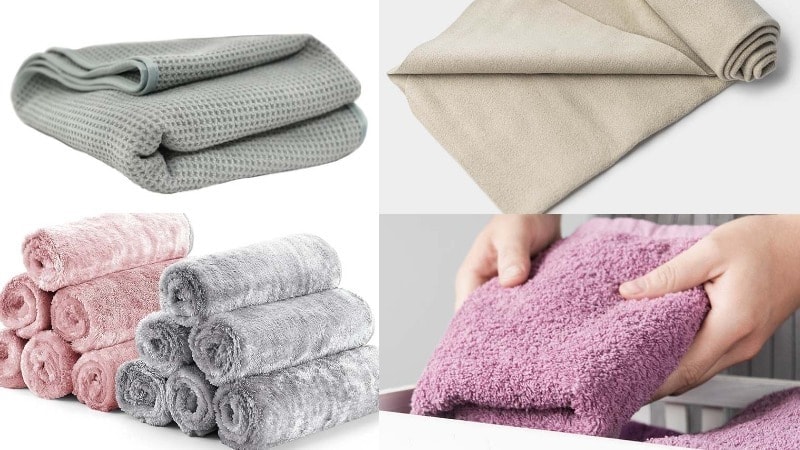
Weaving refers to the process of converting material strands into a fabric sheet. Microfibers generally have four weave options.
Table 1 – Microfiber towel weave options and their performance chart
| Weave Type | Absorbency | Durability | Best Application |
|---|---|---|---|
| Terry Weave | Very High | High | Hospitality, Healthcare, and General Cleaning. |
| Waffle Weave | High | Very High | Automotive Detailing and Kitchen Towels. |
| Flat Weave | Low-Medium | Medium | Cleaning, Glass, Electronic Screens, and Eyewear. |
| Coral Fleece Weave | Medium-High | Medium | Spa & Salon Services. |
Terry weave is the same as your regular cotton towels. It boosts absorbency but is more likely to snag on sharp edges. Flat weave is mostly useful for cleaning sensitive surfaces. It is softer and less likely to scratch surfaces.
Waffle weave is a hybrid design that sits between terry weave and flat weave. They are highly absorbent and softer than terry weave. Finally, coral fleece provides softness and superior performance. So it’s mostly useful for body and facial care.
Antibacterial Properties
Microfiber towels are naturally antibacterial. Making them ideal for sensitive skin care and cleaning food prep areas. With proper storage practices, you can further minimize the risk of bacterial growth.
This decreases the risk of cross-contamination and reduces the need for frequent replacements.
Durable Design
Microfibers stand at the top of the cleaning cloth mountain. Microfiber mops, towels, and cloths all have better cleaning power than cotton options.
Regular cloth will degrade after frequent washing and need to be replaced. By comparison, microfiber cloths stay soft even after repeated washes.
Table 2 – Microfiber towel lifespan comparison chart
| Category | Cotton Towels | Microfiber Towels |
|---|---|---|
| Application | Max Wash Cycles | Life Span |
| Light Use | >120 Cycles | ~2 Years |
| Regular Use | ~75 Cycles | ~1 Year |
| Heavy Use | <50 Cycles | ~6 Months |
The above data assumes you wash your towel twice a week (roughly). The key here is proper care and maintenance. Microfiber towels will only last longer if you wash them properly.
Key B2B Quality Indicators for Microfiber Cloths

Before procuring microfiber cloths, businesses should consider all quality indicators. A high-quality microfiber towel will have some or all of the following indicators.
1. Good Water Absorbency
Water absorbency is your primary quality indicator. Higher absorbency means better fiber blend ratio and higher GSM weight. It also means a streak-free finish when wiping spills and cleaning flat surfaces.
2. Lint-Free Cleaning Performance

All towels and cleaning cloths shed some amount of loose fibers (lint). Microfiber cloths are specially designed to reduce shedding. They give you consistent, lint-free cleaning every time. A true microfiber towel should always give you lint-free performance.
3. Higher GSM (Grams per Square Meter)
Weight is a direct indicator of quality. Two similarly sized microfiber towels will vary in absorption and cleaning performance. If they have different GSM weights.
- 200-300 GSM: Small Cleaning Cloths.
- 300-400 GSM: Dish Towels.
- 400-600 GSM: Body Towels
- 600-1000 GSM: Automotive Detailing Towels.
4. Edge Stitching
The edges of microfiber cloths require specific stitching that doesn’t fray easily. Higher quality stitching techniques are more expensive but result in more durable edges.
- Unstitched Edges: Lowest quality with easy fraying borders.
- Overlocked Edges: Sealing edges with simple thread.
- Ultra Sonic Cutting: Seals towel edges using a high-frequency vibrating blade.
- Hemmed Edges: Overlapping towel material that results in softer edges and improved durability.
5. Color Retention
Color retention, also called color fastness, is a textile property. It indicates a towel’s ability to retain its original dye color after several washes. After washing your microfiber towel, you should look for color fading. Fading means poor dye quality and thus poor towel quality.
Microfiber Certifications & Quality Compliance
Microfiber towels don’t have any specific quality certification or compliance requirements. Instead, towel manufacturers can choose between several different optional certifications.
1. ISO9001
ISO9001 is a quality management system certification by the International Standards Organization (ISO). It ensures that the microfiber towel was made by a company with good quality planning, control, and assurance.
For B2B customers, it means getting high-quality products every time. It also results in reduced risk of damaged or out-of-spec microfiber towels.
2. BSCI

Amfori BSCI (Business Social Compliance Initiative) is not a certification. It is proof of a business’s BSCI membership.
BSCI-marked microfiber products are manufactured with ethical business practices. It means all materials were gathered ethically and that all workers were fairly paid.
3. GRS/RCS
GRS (Global Recycled Standard) and RCS (Recycled Claim Standard) are voluntary, eco-friendly standards. They ensure products on market shelves have the right amount of recycled materials.
- GRS certified means the product contains at least 20% recycled materials.
- RCS certified means the product contains at least 5% recycled materials.
Both GRS and RCS are focused on reducing plastic waste. These standards are also non-applicable to cotton cloths.
4. REACH/OEKO-TEX

Finally, we have two international standards that focus on material safety.
- REACH (Registration, Evaluation, Authorisation and Restriction of Chemicals) is a European regulation. It ensures no harmful chemicals are used in the production of a microfiber towel.
- OEKO-TEX is a Swiss-based standards organization. Its Standard 100 is a textile-specific safety certification. It ensures no harmful substances are present in the production of a microfiber cloth. From material sourcing to packaging.
OEKO-TEX standards are more useful for microfiber cloths. It ensures microfiber towels are safe for babies, the elderly, and immunocompromised individuals.
Understanding Microfiber Customization & Private Labels
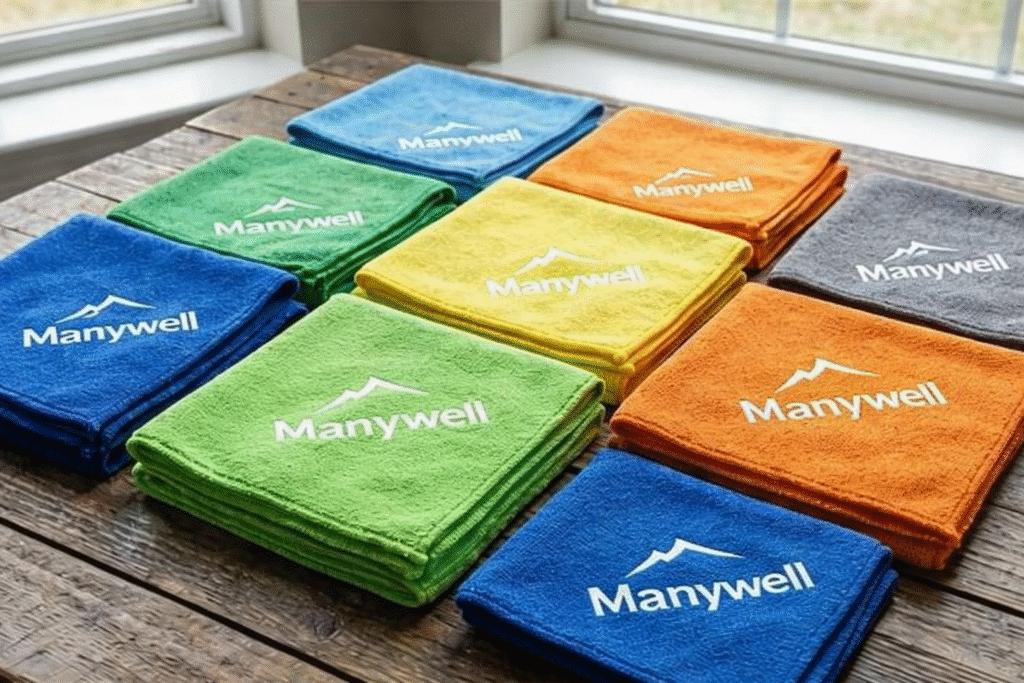
Business-to-Business (B2B) buyers have two customization options. You can either change the surface level specifications or go for a full redesign.
Custom microfiber towels mean products with your brand colors and logo. All cut to your desired size.
Private label means directly working with the manufacturer for a full redesign. It involves custom blends, unique dyes, strict quality control, and more. Several manufacturers offer this as an OEM/ODM service.
1. Custom Microfiber Towels
Simple towel customization is more affordable. Because manufacturers work within their existing workflow. You are not getting anything special. Other competitors can order the same or a similar configuration as well.
These are general cleaning cloths, but customized to stand out from the competition.
2. Private Label Microfiber Products
Private labels involve creating new tools and procuring new supplies. Hence, the higher research and development cost. The simplest example of a private label would be Apple’s $19 polishing cloth.
Apple has a high-weave-density microfiber cloth for specific cleaning tasks. It’s a 6.3×6.3 cloth designed for cleaning delicate surfaces like phone and monitor screens.
Understanding Microfiber Shipping Logistics & Reliability

Once you have your desired product design in mind, it’s time to assess shipping logistics. Procurement of microfiber towels involves a lot of complicated steps. You assess samples, place orders, ensure shipping, and then wait for your products.
a. Minimum Order Quantity (MOQ)
MOQ is a cost assessment metric used by manufacturers. Basically, it is the number at which the producing microfiber cloths become profitable. The MOQ number increases as you increase the customization options.
International shipping generally comes with a minimum MOQ requirement. An additional color change will not impact the MOQ. Customizations, like embroidering the logo on a towel, will increase the MOQ requirement.
b. Lead Time
Lead time is the total time it takes from placing an order to product delivery. Bulk orders, extensive customizations, and large distances increase the overall lead time.
Any type of disruption in the supply chain can result in unwanted delays. Hence, it’s always a good idea to order microfiber towels ahead of time.
c. Shipping Costs & Duration
Shipping any product across large distances will be expensive. Microfiber towels, cotton mops, and other fabric products are more expensive to ship. Because fabrics are lightweight and occupy more space.
Air freight is faster but uses more fuel. Hence, it’s more expensive than shipping by sea. You can either have cheaper shipping or faster shipping. But not both.
How To Check the Quality of a Microfiber Towel?
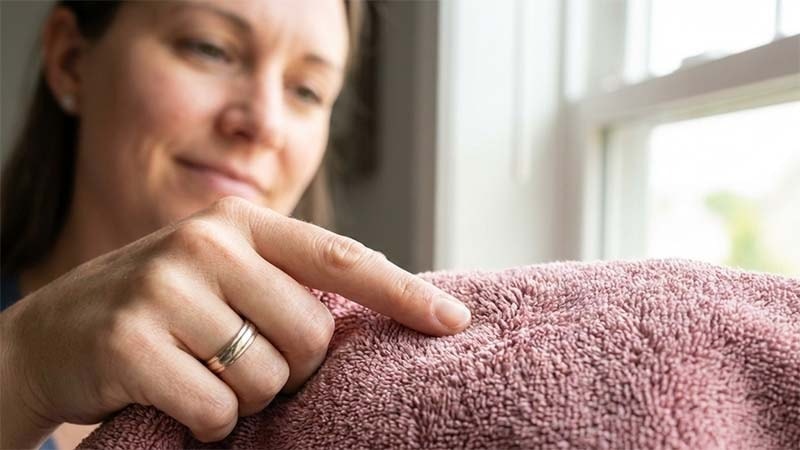
There are several ways to check the quality of a microfiber towel. We recommend that businesses order a few test samples first. Thoroughly test their quality before committing to a larger order.
1. Absorbency Test
The absorbency test is simple. Compare your microfiber cloth sample to cotton and paper towels by cleaning up a spill. A clean microfiber cloth should absorb more liquid than the competition.
If you are ordering samples from multiple vendors, then it’s even easier. The sample with the maximum absorbency is generally the best quality one.
2. GSM Test
GSM is something you decide before ordering. You can confirm the GSM weight of your sample using simple maths.
Weight / (Length x Width * 0.00064516)
- Towel weight in grams
- Towel length in inches
- Towel width in inches
You can also use a simple light test. Hold your microfiber towels in front of a light source. If the light shines through, then it’s a lower GSM towel.
3. Fiber Test
You cannot check the microfiber blend at home. But you can test its softness compared to other brands. A 70/30 towel will always be softer than an 80/20 one. 90/10 or 95/5 blends are the lowest quality variants and have an unpleasant finish.
4. Quality Consistency
This one is a little complicated. Consistent quality means all microfiber products from this manufacturer are similar in quality. But you cannot judge that based on one sample.
For the consistency test, you will need to order several towels. Then check if their weave density, stitching, and color have consistent quality.
5. Wash Test
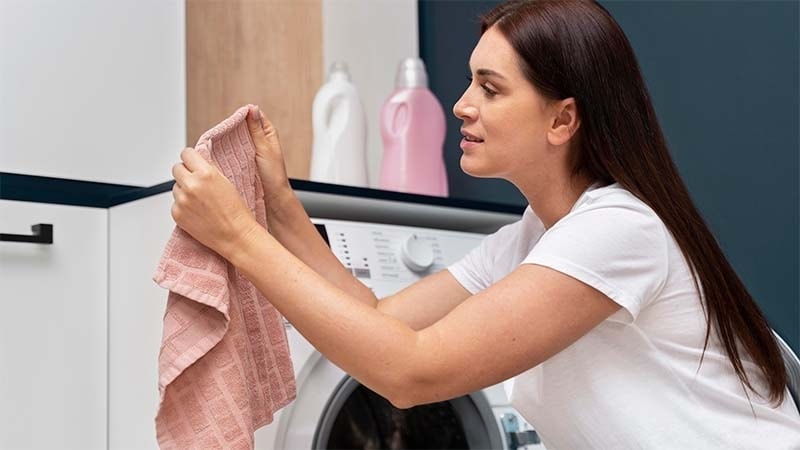
Washing microfiber towels is the quickest way to determine their quality. Microfiber towels should be washed with cold (or warm water) and a gentle detergent.
You may see some loose fiber on your first wash. All towels shed once they leave the factory. However, no towel should shed after multiple washes. There should also be no color fading or bleaching with mild detergents.
Just a heads up, avoid using bleach and fabric softeners. Bleach will fade synthetic and natural fabrics. So it ruins the test parameters. Avoid fabric softeners because they can clog up the microfibers, affecting their absorbency.
6. Drying Test
Lastly, you have the air-dry test. Microfiber cloths are quick-drying. When drying dishes, microfiber cloths should dry faster than equivalent cotton cloths. This test is less accurate outside of lab settings. So be careful. However, you can test post-drying softness.
Microfiber towels get hard and rough under direct sun drying or heated tumble drying. But air drying should always result in a soft texture. Lower-quality microfiber cloths get rough even after proper air drying.
Conclusion
Choosing the right microfiber towel for your business isn’t easy. First, you need to understand microfiber variations and customization options. Then, plan a suitable procurement strategy to ensure the lowest upfront investment. Finally, you have to thoroughly test samples before committing to a large order. Use this guide, and you will have a much easier time purchasing microfiber cloths.
Get Premium Microfiber Cleaning Supplies from Manywell!
Manywell is a B2B cleaning supplies manufacturer specializing in microfiber towels, microfiber mops, and disposable cleaning cloths. All our products are fully customizable. Procure custom towels for your business with your choice of GSM, sizing, packaging, and labeling.
We offer flexible MOQ options for small businesses and considerable discounts on bulk orders. Our 13,000 sq m factory and 150+ employees are perfectly suited for high-volume production.
For technical specifications, lead times, and volume-based pricing, procurement teams can contact us now for a Free Quote.