
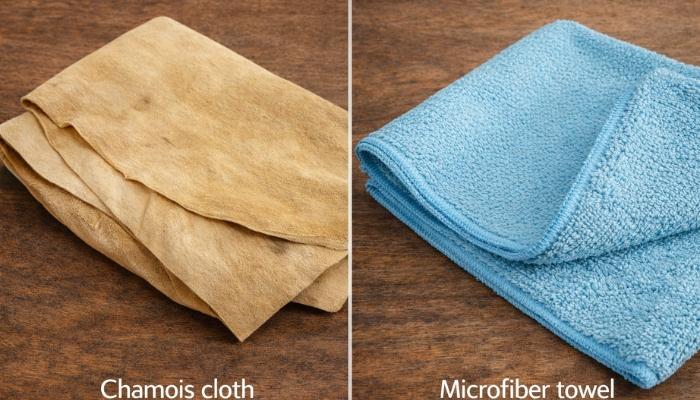
In the debate between chamois and microfiber towels, each has its own pros and cons. For a business, what matters most is which option best suits their use case. Businesses also have to balance the acquisition cost and functional efficiency. To help you choose between the two, we have compared them on various factors. This article will help you find the best option for your use case.
Microfiber Towels: A Quick Overview
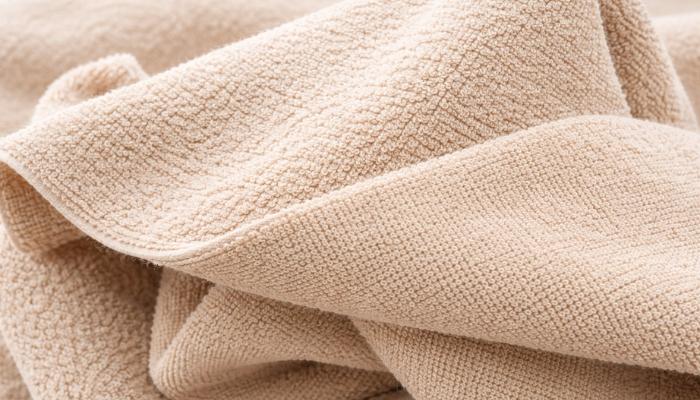
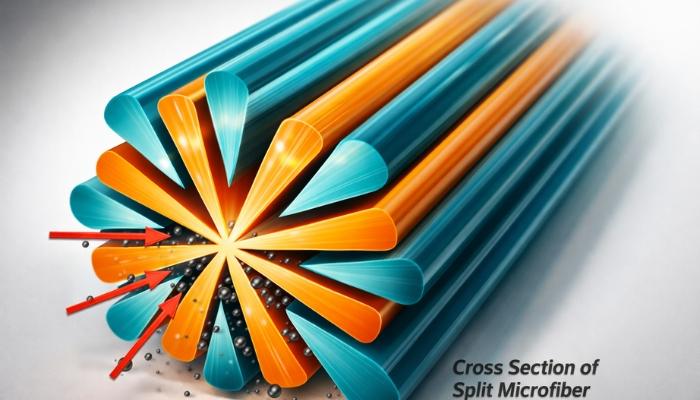
Microfiber towels are synthetic towels made of polyester and polyamide. Each microfiber is 1/20th of the diameter of a silk thread. These fibers have a polyester core that splits along its length. In these splits, polyamide fibers are knitted.
This asterisk-like shape creates tiny hooks that grab dirt without smearing. Splitting also boosts the surface area by ten times, which improves absorption. The polyamide part attracts water. The polyester component attracts oil and grease and pulls them off.
Chamois Cloths: A Quick Overview
Chamois cloth originated from the skin of the chamois goat. Nowadays, chamois cloths are produced with synthetic fibers. This synthetic material is engineered to mimic the original’s behaviour.
Chamois cloths have a soft surface. They can absorb a significant amount of water while drying your car. Chamois towels function like a squeegee. They push water off the car.
Chamois vs Microfiber: Performance Comparison At a Glance
There are various types of drying towels on the market. Each type is better suited to specific use cases. While two types of towels can do the same job, one usually works better.
For basic usage, differences in performance may go unnoticed. However, this distinction becomes particularly important in large-scale commercial use cases.
A business should compare various options to find the best fit for its needs. In this section, we will compare chamois and microfiber across 6 key criteria.
Absorbency & Drying Speed
In the matter of absorption and drying process, both perform well. Microfiber towels have maximum absorbency potential. This property is due to their split-fiber structure, high surface area, and polyamide’s affinity for water. Chamois are great at soaking up water. Using a chamois towel, you achieve streak-free results on the glass. The only problem is that chamois towels require constant wringing, which is a hassle.
Dirt Removal & Surface Protection
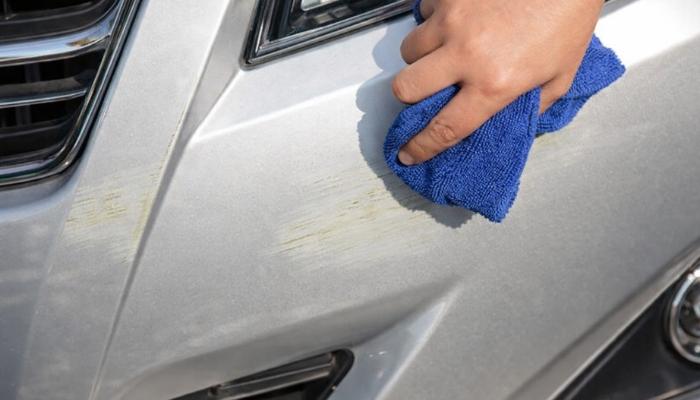
Microfiber towels remove dirt physically and electrostatically. The charged nature of polyester and polyamide attracts the oppositely charged dirt. Also, the tiny grooves in fibers pick up dirt. Chamois towels are not as effective at removing dirt. They are gentle on the sensitive surfaces. However, if not properly cared for, they can cause scratches.
Streak-Free Results & Maintenance
High-quality microfiber cloths are designed to provide streak-free results. Natural chamois cloths also provide streak-free results on glass, mirrors, and painted surfaces. Their natural fiber are more gentle. When using a microfiber towel or chamois, maintenance is important. In comparison, aftercare for microfiber cloths is easier than for chamois cloths.
| Comparison Criteria | Microfiber Cloth | Chamois Towel |
|---|---|---|
| Water Absorption | Microfiber towels have excellent absorption. Don't require wringing. | They’re popular for drying cars, but need to be wrung out often, |
| Dirt-Removing Power | Microfiber towels trap dirt particles. Their ultra-fine fibers lift dust from the surface. | Chamois towels don't have strong dirt-removing properties. |
| Surface Protection | Microfiber cloths have a plush surface and are gentle on the paint. | Chamois cloths are soft, but they can scratch surfaces. |
| Efficiency | Microfiber towels don't require wringing. | Chamois needs to be pre-dampened to work and requires constant wringing. |
| Maintenance | They release dirt easily and so can be machine-washed. | Chamois should be washed with hands after use. |
| Cost Difference | Have a higher upfront cost but lower replacement frequency. | Lower initial cost. Thus, frequent replacement may be required. |
Analysis of Pros & Cons
Choosing the right towel type is a key decision for businesses. This is because the type of towels they use can affect both cost and efficiency. It is especially true for car detailing services. Their model focuses on cleaning and drying. Thus, they need high-quality towels to dry surfaces and get streak-free results.
To make the decision easier, we have explained the pros and cons of each option. After reading this section, you will be able to evaluate which option holds more value for you.
Microfiber Cloths
Here’s a table comparing the pros and cons of microfiber drying towels;
| Pros | Cons |
|---|---|
| MF towels are highly absorbent because of the fiber split | They have a higher initial acquisition cost |
| It can dry-wash a surface without excessive water | Multiple microfiber towels are required for different tasks |
| Don't leave scratches or swirl marks | Must be laundered in separate wash cycles |
| High-quality microfiber cloths are lint-free | Prone to static electricity in a dry environment |
| They have a long service life. Can last upto various machine cycles | High temperatures can cause fiber deformation during washing |
It is evident that the pros of a microfiber cloth outweigh the cons. So if these cons aren’t a deal-breaker for you, you can choose microfiber towels.
Chamosis Towels
Here are the pros and cons of chamois towels
| Pros | Cons |
|---|---|
| Chamois towels can absorb excessive water and quickly air dry | Natural chamois degrades over time. So, the towel becomes less effective and more prone to scratching |
| One towel can be utilized for multiple purposes | Care of a chamois towel is hard. They need to be damp before using them |
| They can withstand multiple wash sessions | Cannot work efficiently with little water. Excessive water and chemical use can add to your overall expense |
| They don't shed lint or fibers | They are difficult to use and require proper technique |
| Synthetic chamois are highly durable and can last a long time | Chamois towels cost more than microfiber cloths. |
| They are soft and deliver streak-free results on delicate surfaces such as paint and glass. | Chamois towels drag along the dirt particles, which causes micro scratches |
Applications: Best Use Scenarios
Just like cotton vs. microfiber cloth, chamois and microfiber can both do a cleaning job. Yet, one can be more suitable for a job than the other. So, we have categorized each based on its best usage. In this section, you can quickly find the right match for our use case.
For Car Detailing
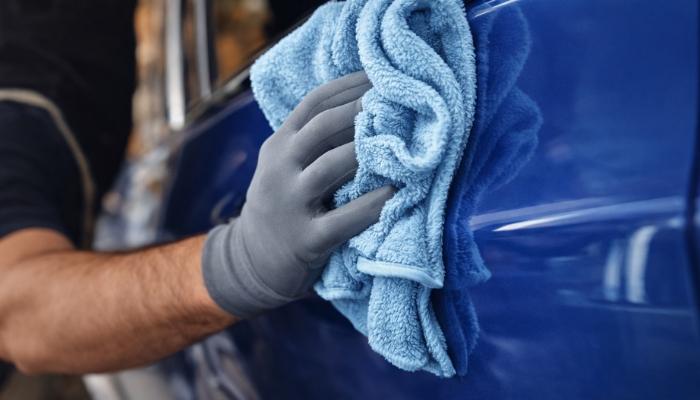
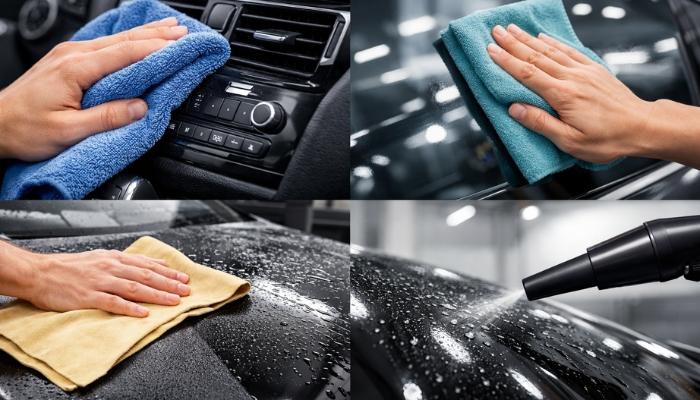
Since car detailing means deep cleaning, microfiber cloths are the best for this purpose. Microfiber towels are preferred for their ease and ability to trap microscopic dirt particles. Moreover, they can absorb a significant amount of water without reaching saturation. Unlike chamois, they also don’t require frequent wringing. So, for polishing and detailing, microfiber is a winning choice.
For Bulk Drying Large Surfaces
For full-scale car washes, microfiber cloths come through. They have a large surface area. This larger area helps absorb extra water quickly. The grooves in the fiber create capillary action that helps absorb water. So, microfiber cloths are more efficient for bulk drying in car washes.
For Streak-Free Finish
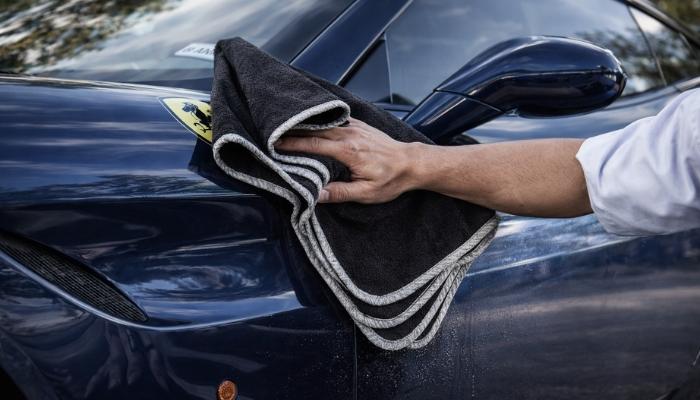
Microfiber cloth and chamois cloth both give a streak-free finish. Chamois cloths need the right technique for consistent results. For high-end paint jobs, natural chamois towels are recommended for streak- and scratch-free results.
For Car Drying
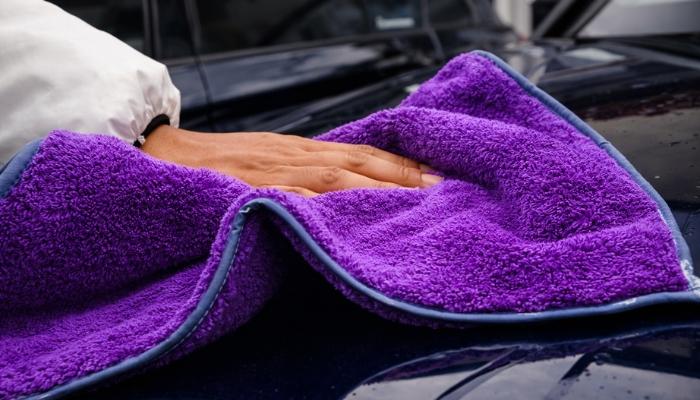
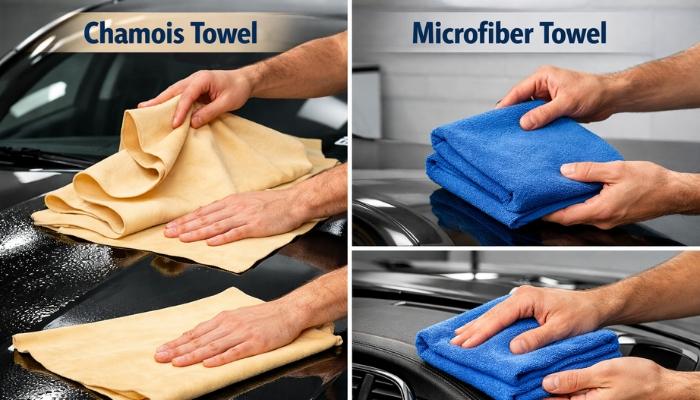
Among auto enthusiasts, microfiber cloths are popular for the job of drying. It is because of their absorbency and softness. Waffle-weave drying towels are preferred for drying your vehicle. Chamois cloths are great for drying windows. You can also use them to wipe dashboards and center console screens.
For Delicate Surfaces
Microfiber towels are great for getting streak-free results on glass. They are easy to use and don’t scratch. So, for delicate surfaces like glass, mirrors, and screens, microfiber is the choice. Old chamois cloths can leave scratches as they tend to drag dirt.
For Contact-Free Drying
Alternatively, blow-dry the surface using a leaf blower. This is a good option for contact-free drying. It eliminates the risk of scratching or swirl marks. However, it’s a costly choice for businesses. Blowers are pricey and consume a lot of electricity.
Maintenance Guide: Ease of Washing and Reuse
Businesses need to understand the upkeep routine of each material. After-care impacts both cost and long-term use. So, it is recommended to choose an option whose routine you can follow. Following is the maintenance guide for both the towels
Microfiber Cloth
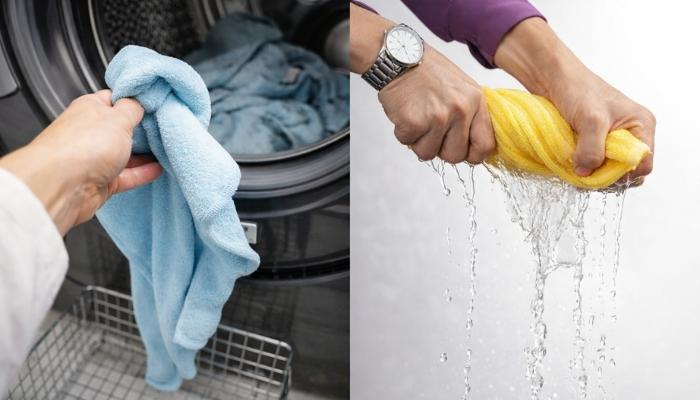
Microfiber towels need to be washed after each use to maintain their effectiveness. The steps to wash the microfiber towels are as follows
- Step 1: Shake the towels vigorously. This step will remove the loose dirt.
- Step 2: Separate the towels based on the extent of contamination. This step prevents cross-contamination.
- Step 3: Load the washing machine up upto 3/4 level. Don’t wash a microfiber cloth with other cloths.
- Step 4: Use a mild soap. Harsh detergents may impact fiber quality and reduce efficiency. Use slightly heated water to clean and remove stubborn dirt. Don’t wash microfiber with bleach or fabric softener.
- Step 5: Air dry the microfiber cloth. Alternatively, you can use dry heat at 60° C.
Chamois Cloth
Chamois maintenance is more technical. Given their natural origin, chamois towels need more care. Here are the steps required for after-care of chamois towels;
- Step 1: Rinse under running water immediately after use. For this step, lukewarm water is preferred to soften the dirt.
- Step 2: Now, the chamois needs to be washed with hands. Gently knead the chamois to release embedded dirt.
- Step 3: It is preferable to use a mild, non-alkaline soap. Leather chamois can get damaged by harsh detergents and soaps.
- Step 4: Thoroughly rinse under running water. It removes the dirt and detergent residues.
- Step 5: Wring out the chamois carefully to remove excess water.
- Step 6: It is not recommended to wash chamois towels in a washing machine.
- Step 7: Store in an air-tight container to prevent it from completely drying out.
Thus, it is evident that the chamois towels require special attention to maintain their efficiency. Businesses working on tight schedules may prefer microfiber cloth due to its easier handling.
Buying Guide: Choosing Microfiber Towels Or Chamois
Finalizing whether you need a microfiber cloth or a chamois cloth is one thing. However, choosing the right towel with the desired qualities is another side of the equation. So, in this section, we’ll cover the features to look for when choosing between microfiber and chamois towels.
When Buying Microfiber Cloth
Microfiber towels are well-suited for commercial needs. It is because of their construction and properties. Moreover, microfiber towels can also be customized and privately labelled. So, as a business, you should look for the following features;
- Weight per Square Meter: Choose a towel with a GSM of 300–500 g/m². This GSM is suited for optimal performance. However, if your use case requires high absorption, you can opt for a higher GSM.
- Loop Structure: Look for manufacturers that produce products with fine loops and no clumping. Manywell is a full-scale manufacturer that allows complete customization. You can request the customized loop type and structure.
- Fiber Composition: Look for manufacturers that offer an 80/20 or 70/30 ratio blend. A 100% polyester or 90/10 blend may seem good, but they are less absorbent. So, anything lower than 20% polyamide ratio should be avoided.
- Lint Shedding: Quality microfiber towels don’t shed lint when used on wet surfaces. This parameter can be confirmed through quality certificates. ISO 4484-1 or AATCC TM212 standards indicate that the towel will not lint.
When Buying Chamois Cloth
Chamois cloths can work in commercial settings. However, they are more suitable for personal use. So, look for the following features when buying chamois towels;
- Thickness: The thickness of chamois towels relates to their absorption capacity. So, look for higher thickness for better absorption.
- Edging: This criterion is very important in determining a towel’s lifespan. Opt for chamois towels with secure, reinforced edging. Strong edges ensure that the towel doesn’t fray or shed.
- Texture: It is another indicator of the quality. Look for options with a smooth surface and no odour.
Conclusion
Microfiber cloths and chamois towels both have similar functions. Yet they differ significantly in performance. As the analysis above shows, microfiber has been the clear winner in most use cases. It is because of their dual fibers and split technology. So, if you’re still unsure about microfiber vs. chamois, test both on your vehicle under real-world conditions.
Upgrade Your Car Detailing Service with ManyWell®’s Functional Microfiber Cloth
ManyWell® is a skilled manufacturer dealing in high-quality cleaning products. Our products range from microfiber towels and mops to cleaning brushes and tear-away cloth rolls. With 18+ years of experience, we offer complete OEM/ODM customization. Our in-house QC ensures the product meets your requirements exactly.
So, if you are deciding between microfiber and chamois cloths, let us help. Contact us today, and we’ll send you a sample of our waffle weave microfiber towel. Test it against chamois in real conditions and choose the option that works best.