
GSM is one of the most common ways of advertising microfiber towels. It’s a way to measure the density of a towel. Surprisingly, it has a big impact on your cleaning performance. But the results may surprise you.
In this article, we explain the basics of microfiber towel GSM, its impact on cleaning performance, and share recommendations based on applications.
What Does GSM (or Grams Per Square Meter) Mean?
GSM is a textile industry term used to describe the amount of material in microfiber cloths, cotton towels, and other fabrics. It stands for grams per square meter.
You often hear that higher GSM means the towel’s quality is superior. However, the reality of the situation is more complicated. An increase in GSM means more synthetic fibers packed into a towel. Which means more absorbency, more weight, and more money.
It’s better to look at common towel GSM ranges and their best applications. We’ll discuss high vs low GSM towels in a short while. For now, let’s talk about cleaning performance.
How Does GSM Impact Towel Performance?
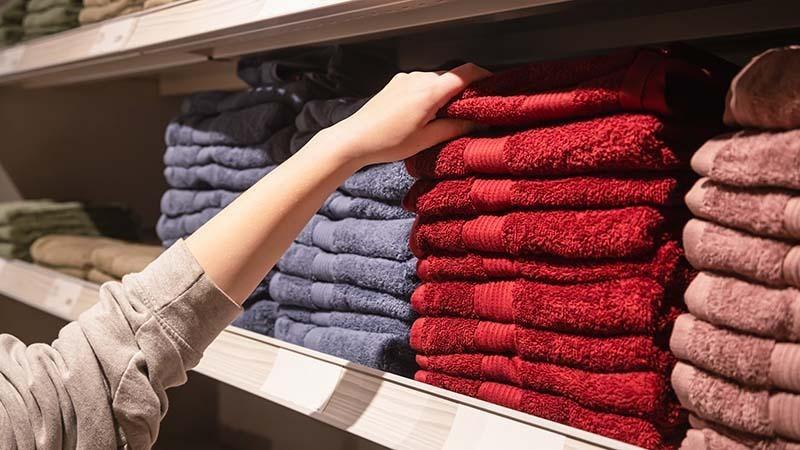
Here are seven elements of a microfiber towel that are affected by GSM.
- Water Absorbency: Higher GSM increases towel mass, which increases absorbency.
- Drying Speed: Heavier GSM towels are so thick that it takes a long time for them to dry.
- Streak Free Cleaning: Higher GSM towels are more absorbent and therefore less likely to leave streaks.
- Lint-Free Performance: Low GSM towels use a flat weave, which is less likely to lint.
- Durability & Lifespan: Heavier towels are more durable because of their size and weight.
- Cost & Value: The raw material, manufacturing, handling, and shipping costs all increase with GSM.
- Ease of Use: Lower GSM towels are thinner, easier to carry, and useful in all situations.
Guide to Basic GSM Options for Microfiber Towel
Generally speaking, we can divide towel GSM into four groups. Ranging from ultra-low GSM to luxury high GSM microfiber towels.
200–300 GSM (Lightweight)

200 GSM is the minimum we recommend for any business. This lightweight towel category is used for all sorts of cleaning tasks. Since lower GSM microfiber results in an overall lighter towel. We recommend using it for your beach towels.
In the opposite direction, you have small glass cleaning towels. These towels are recommended for cleaning delicate surfaces like eyewear, phone screens, car mirrors, and windows. Here, you don’t need high water absorption. Instead, prioritize softness and handlability.
These towels also air dry quickly, which makes them more convenient. Size plays a big role in GSM and towel performance. Learn more about microfiber towel sizes.
Advantages
- Easy to Handle
- Quick Drying
- Cost-Effective
- Lower Chances of Linting
Disadvantages
- Lower Absorbency
- Not Suitable for Heavy Spills
300–400 GSM (General Use)
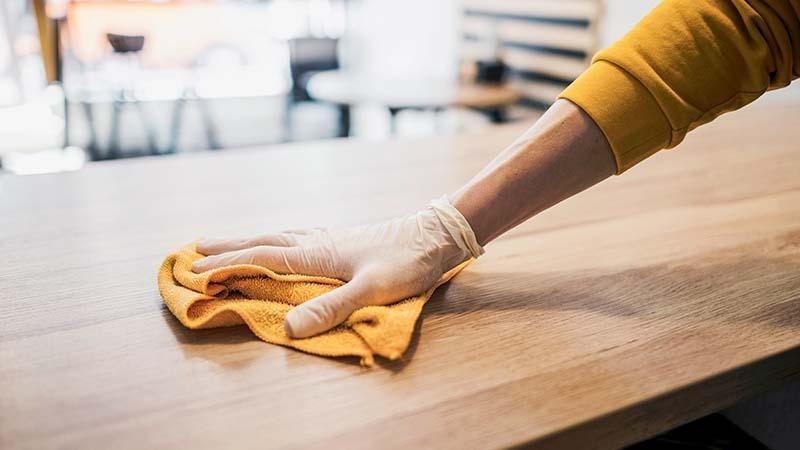
300-400 GSM is the most popular towel category. It hits the perfect sweet spot between performance, price, weight, and usability. There are so many applications for medium GSM microfiber towels.
- General Surface Cleaning (Walls, Tables, Railing
- Kitchen Cleaning Towels
- Dish Drying Towels
- Automotive Interior Cleaning
- Spill & Dirt Clean Up
- Sanitizing Applications
- Polishing & Clear Coat Applications
There is no right towel for every application. But medium GSM towels are good quality towels that are an essential tool for general cleaning tasks. With proper care, these towels can last a very long time.
These towels also come in several designs and configurations. You can get them in different weaves (twisted loop, waffle, flat, coral fleece) and edge stitching options (overlocked & edgeless towels).
Learn more about overlocked edges and edgeless towels.
Advantages
- Balanced Performance
- Cleaning Versatility
- Durable & Long Lasting
- Comes in Different Styles
Disadvantages
- Less Soft than Premium Options
- Less Absorbent than Premium Options
400–600 GSM (Premium Feel)

400-600 GSM range microfiber is the gold standard for towel manufacturing. These are higher-quality towels with a matching price tag. This category caters to two types of customers.
- Customers Seeking a Soft & Luxurious Skin Feel
- Customers Seeking Superior Absorbency in Cleaning
Microfiber towels with high GSM weight are super soft and highly absorbent. So naturally, most hotels use them as bath towels. This gives guests a luxurious and premium feel.
For the practical customers, high GSM stands for scratch resistance. It offers maximum softness, which is great for cleaning stainless steel, digital screens, and car surfaces. These microfiber towels ensure zero scratches and zero paint damage.
Advantages
- Highly Absorbent
- Soft Feel
- Durability
- Scratch-Resistant
Disadvantages
- More Expensive
- Slightly Heavy
- Longer Drying Time
600–1200 GSM (Heavy Duty)
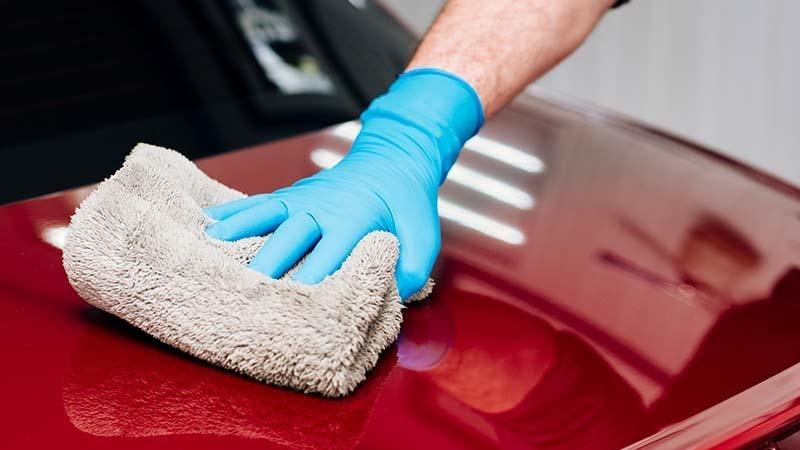
After 600 GSM, you can go as high as you want. It will result in towels that are thick and heavy but incredibly absorbent. In our opinion, anything over 600 GSM ends up in the region of diminishing returns.
This means doubling the GSM will not necessarily double the water absorbency or cleaning performance. But there is a very good reason why towel manufacturers produce very high GSM towels.
The automotive detailing industry really likes these high GSM towels for drying cars. Because they give a guaranteed streak-free finish. A single wipe across a wet car will soak up all of the water. Meaning no water spots, streaks, or swirl marks.
Outside of car detailers, industrial cleaners, and boat maintenance also utilize ultra-high GSM towels. Most detailers use 600-800 GSM towels for cars and 1000+ GSM towels for large vehicles like SUVs or Pickups.
Advantages
- Maximum Absorbency
- Streak Free Finish
- Scratch-Resistant
- Soft Towel Surface Area
- Durable & Long Lasting
Disadvantages
- Most Expensive
- Very Heavy
- Limited Applications
- Very Slow Drying
- Requires More Storage Space
- Harder to Wash
High GSM Towels vs Low GSM Towels
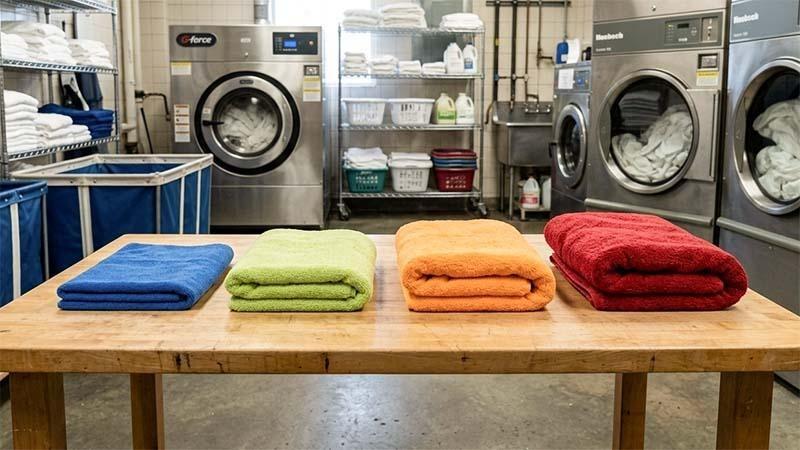
The right tool makes your job easier. It’s not always a competition of pure specifications and GSM numbers. In this section, we directly compare the properties of low and high-GSM towels.
Table 1 – Properties of low and high-GSM towels.
| Towel Feature | Lower GSM | Higher GSM |
| Weight | Lightweight | Heavy |
| Common Weave Options | Flat or Waffle | Twisted Loop |
| Absorbency | Medium-High | Very High |
| Drying Times | Fast | Slow |
| Ease of Handling | Excellent | Moderate |
| Softness | Medium | Very Soft |
| Scratch Resistance | Excellent | Excellent |
| Streak Resistance | Good | Excellent |
| Applications | Versitile | Limited |
| Initial Cost | Affordable | Expensive |
| Maintenance Requirements | Minimal | High |
Best GSM for Different Applications

So what is the best GSM for a microfiber towel? Here are five major applications of microfiber towels, and our recommended towel GSM weight.
1. General Cleaning Towels (300-400 GSM)
For general cleaning in hotels, restaurants, offices, and stores, we recommend medium GSM microfiber towels. These towels will give you good absorbency while being relatively lightweight.
2. Car Detailing & Drying Towels (500-1200 GSM)
400-500 GSM towels for car washing applications. We only recommend 600+ GSM towels for car drying tasks. These towels will give you the highest absorbency and a guaranteed streak-free finish.
3. Delicate Surfaces / Glass Cleaning (200-350 GSM)
Low GSM towels with a flat weave and smooth texture are the best for delicate surfaces. Absorbency isn’t the goal here. You mostly want a scratch and streak-free finish.
4. Commercial Cleaning Towels (200-600 GSM)
For heavy-duty commercial cleaning, you need several different microfiber towels.
- 200 GSM: For sealant removal, grease clean-up, and ceramic coating residue removal.
- 300 GSM: For toilets. sinks, and other hazardous areas.
- 400 GSM: For walls, furniture, and appliances.
- 500-600 GSM: For heavy spills, sticky messes, and grease.
5. Body Care (Hotels, Spas, Resorts) (400-600 GSM)
Body care (bath, hand, and pool) towels require a high GSM. It gives the towels a soft texture and high absorbency. It also shows that your business doesn’t skimp out on essentials.
Testing Towel GSM & Manufacturer Claims
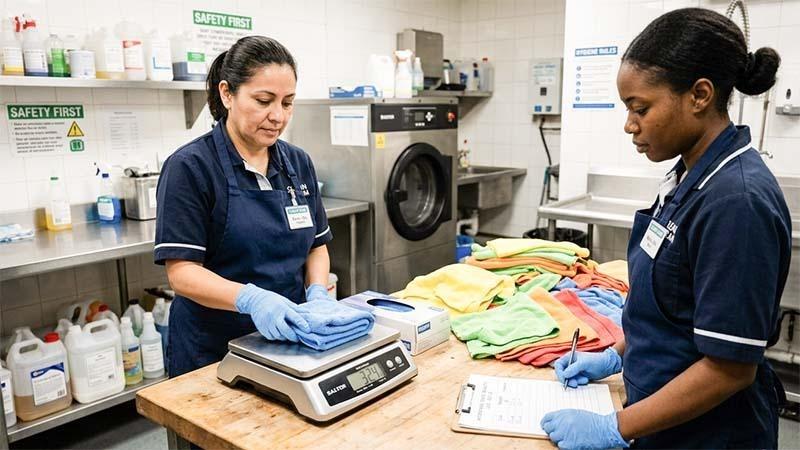
Ask the microfiber towel factory for a sample. Then test the sample GSM and compare it to the manufacturer’s claimed number.
Step 1: Measure Your Sample Towel’s Size
Measure the length and width of your towels in inches. Then calculate the area of your sample towel.
- Area (sq.meters) = Length (inches) x Width (inches) x 0.00064516
Step 2: Weight the Microfiber Towel
Now measure the weight of your microfiber towel. Make sure your measurement is in grams. If your scale is in pounds (lb), use the following conversion.
- Weight in Grams = Weight in Pounds x 453.6
Step 3: Use the Formula to Calculate GSM
Use the following formula to get a GSM value for your sample towel.
- GSM = Towel Weight / Towel Area
- Where, weight should be in grams & area in meters squared.
Step 4: Compare Calculated GSM to Manufacturer Claims
Compare your GSM number with the manufacturer’s claims. Most factories have a 5% tolerance. Meaning the weight of the towel may be 5% lower or 5% higher.
Conclusion
Understanding GSM will help you optimize your microfiber towels. While high GSM comes with a lot of advantages, it’s not always necessary. You also need to consider the price, application, and ease of handling. Use this article to optimize your microfiber towel procurement plan for your business. Just remember to balance your budget with cleaning requirements.
Get the Best Microfiber Towels from Manywell!
Manywell is a manufacturer and supplier of high-quality and long-lasting microfiber products. Our catalog is full of microfiber cleaning towels, beach towels, disposable cleaning cloths, microfiber mops, and more.
We offer full customization options, including towel size, weave, color, and GSM. You can also request early samples before committing to a larger order. Get a Free Quote Today!