
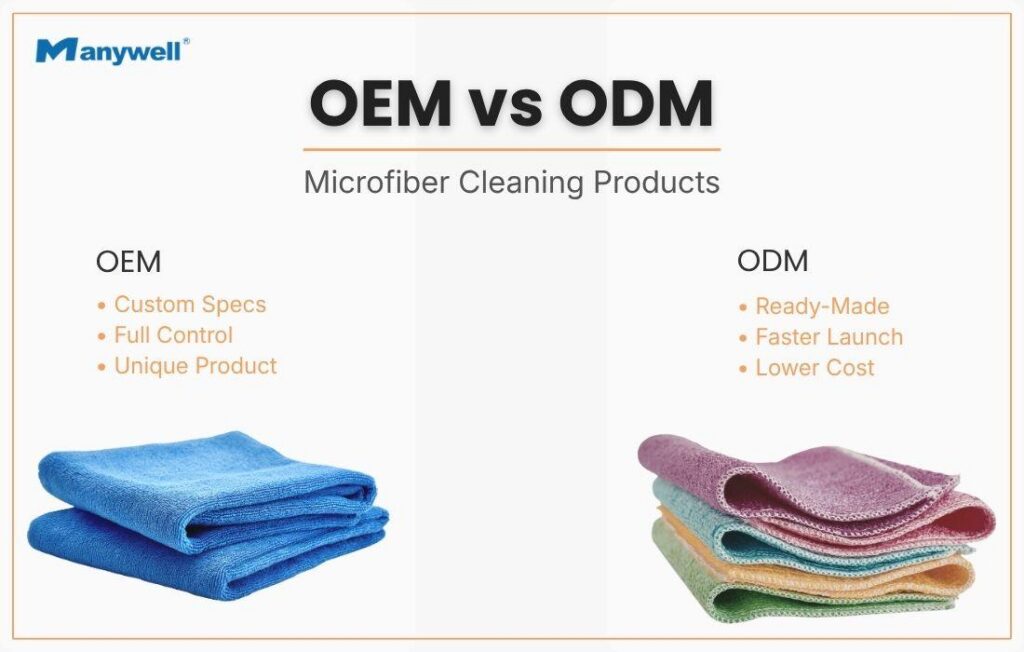
Microfiber cloths have much more potential than just being glass-safe cleaning cloths for your windshields. This niche is full of custom options that can give your business a unique USP and help you stand out in the market.
But this is also where you need to choose between OEM vs ODM microfiber cleaning products. The microfiber cleaning products sourcing method you choose moving forward matters. In this guide, you’ll learn how both models work and how to choose the one that fits your business.
What Does OEM Mean in Microfiber Cleaning Products?
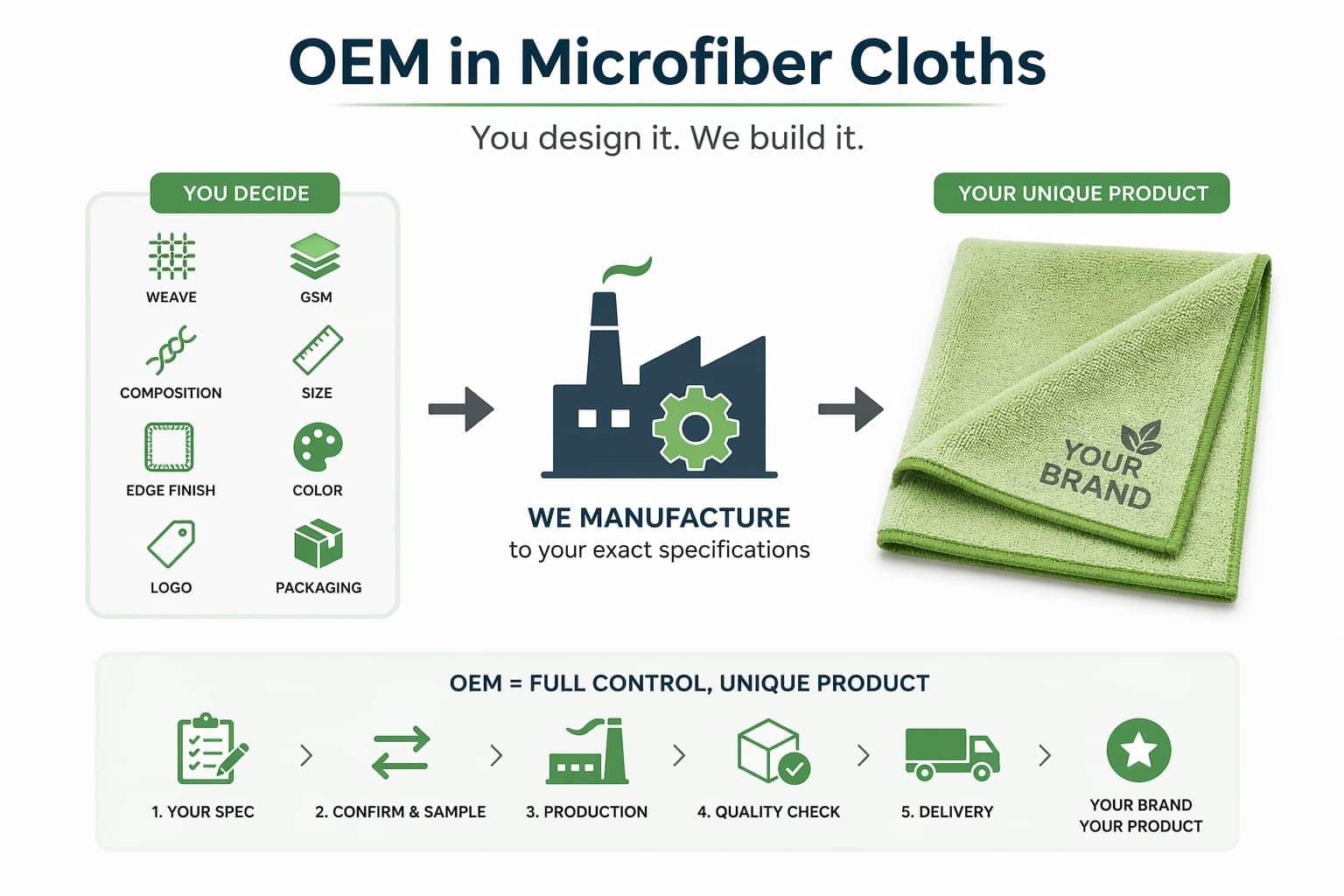
When you can’t compromise on performance and quality, OEM is where you go. Original Equipment Manufacturing means there is no catalog. The product is built entirely to your requirements, bringing together the exact microfiber specifications you need.
You get to decide between microfiber towel customization options: size, GSM, fiber composition, weave, pile height, edge finish, logo method, wash tolerance, lint threshold, carton marking, and pack-out rules. You define each detail, and the original equipment manufacturer’s role is to deliver it consistently.
What Does ODM Mean in Microfiber Cleaning Products?
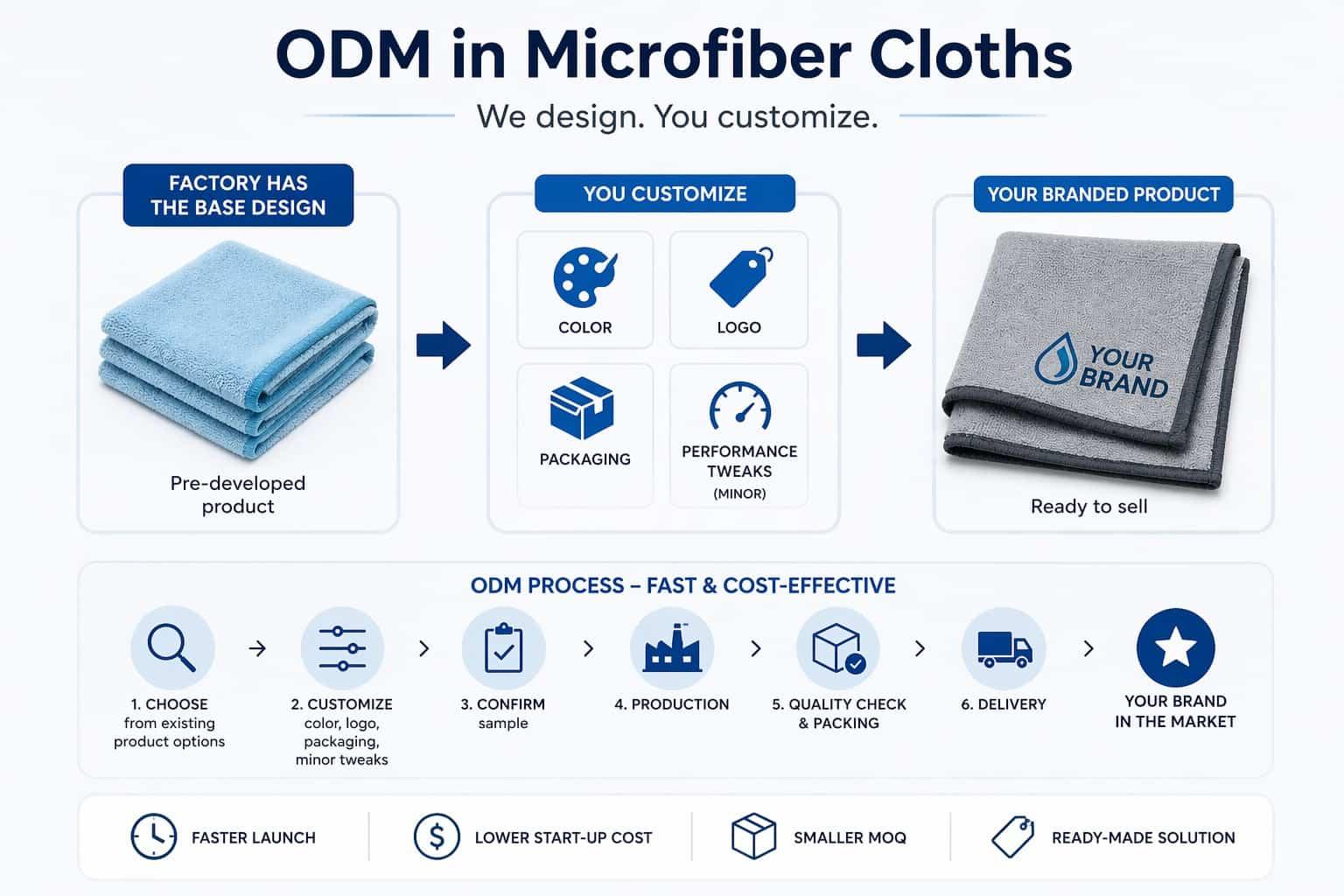
ODM refers to when you’re working with a formula already developed by the custom cleaning products supplier. This means the microfiber cloth design is typically selected from the original design manufacturer’s existing catalog.
You can still make minor changes to the product, such as color, logo, packaging, or small performance tweaks for product differentiation. They are often used in private labelling arrangements.
This, in turn, improves the quality of microfiber towel, as the core design remains the same. Original Design Manufacturing comes ready in a structured format, saving you both time and cost. Instead of spending weeks on R&D, you can move straight into production with lower upfront investment to bring new products to market faster.
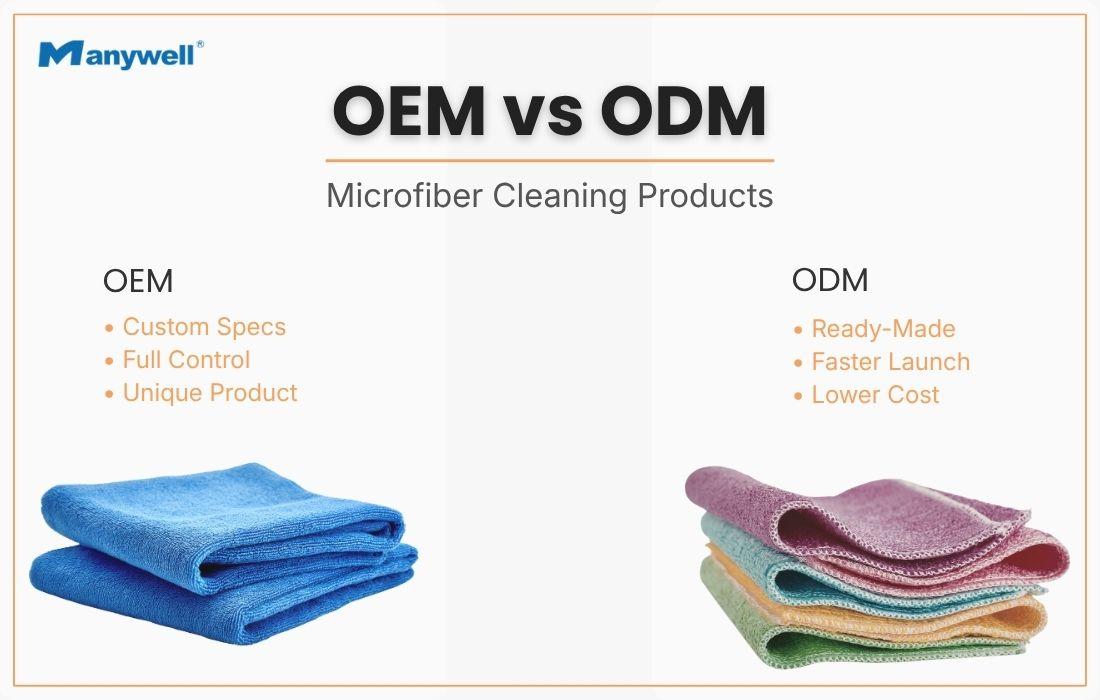
OEM vs ODM: What’s the Main Difference?
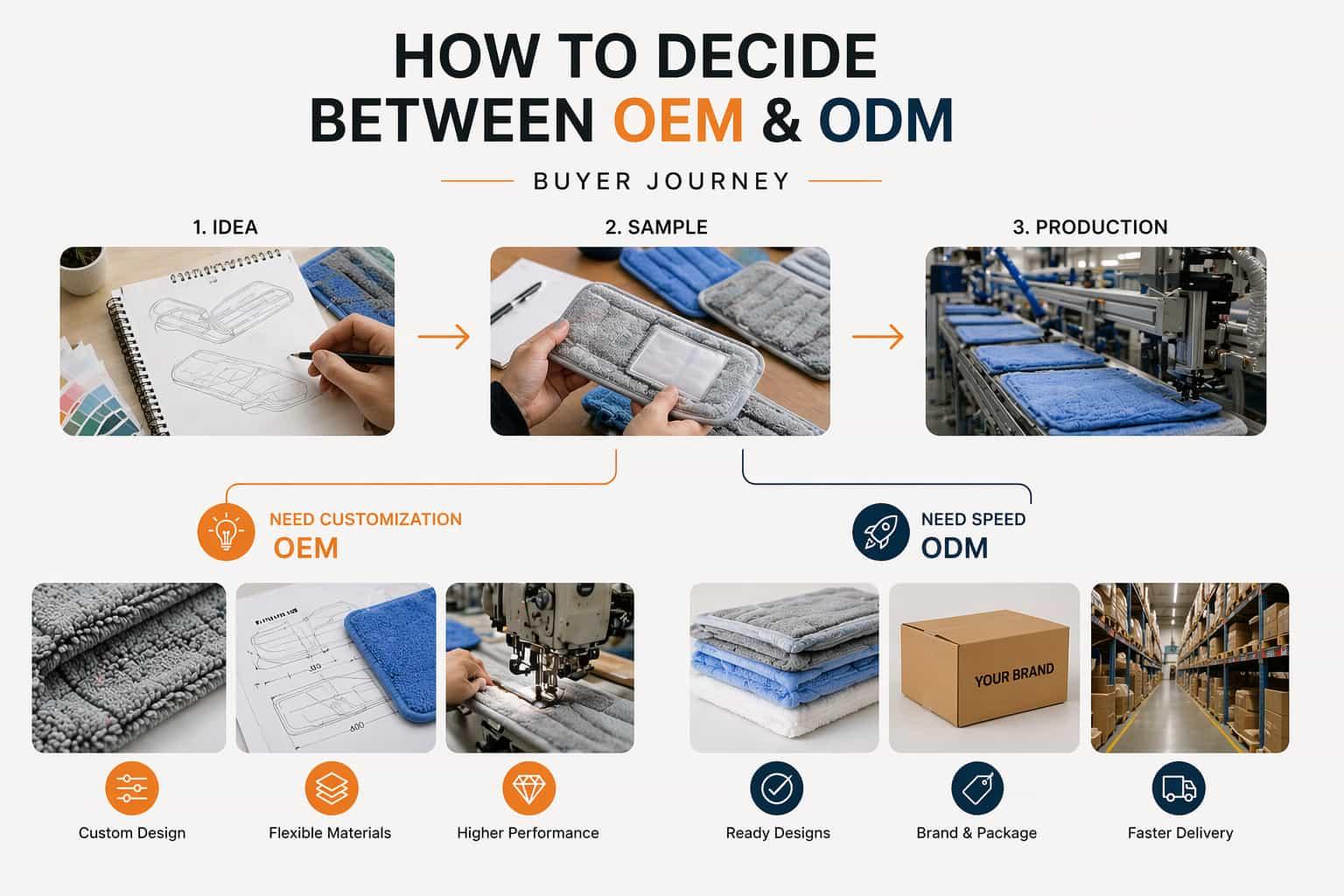
The following table cuts through everything and highlights the major differences, helping you decide which model to lean toward.
| Model | OEM | ODM |
|---|---|---|
| What it means in practice | The factory builds the product entirely to your specifications | The factory provides a ready-made product that you customize slightly |
| Who owns the specs | Buyer / brand | Mostly factory |
| Speed to launch | Moderate | Fast |
| Differentiation | High | Medium to low |
| Cost (initial) | Higher (R&D, sampling, tooling) | Lower |
| MOQ | Higher | Lower |
| Lead time | Longer | Shorter |
| Main risk | Requires strong control and clear specifications | Product may not be unique and can be reused by others |
Which Is Better for Microfiber Cleaning Product Buyers?
Looking at cost and speed alone when choosing between OEM vs ODM manufacturing models will only work for a handful of buyers. The real difference, especially when sourcing microfiber cleaning products, comes down to how much control you have over the product.
At the end of the day, the decision is subjective. It depends on your goals, your budget, and how seriously you want to invest in differentiation.
OEM may be better if you:
- Already have a defined brand identity
- Need custom sizes, GSM, colors, stitching, or packaging
- Want to offer differentiated microfiber towels or mop pads
- Sell into retail, wholesale, or branded channels with specific requirements
- Need compliance, labeling, or packaging aligned with your market
ODM may be better if you:
- Want to launch quickly
- Are testing a new market
- Have a limited development budget
- Prefer lower complexity in sourcing
- Want to start with proven product structures already used in the market
OEM vs ODM for Different Microfiber Cleaning Product Categories
As a business, you need to understand your product entirely, from the fabric used to the stitching. The difference between ODM vs OEM microfiber cleaning products becomes far clearer. And then, you can proceed to align your choices with market demand, market positioning, and your overall product strategy.
Microfiber Towels
OEM is where brands selling exclusive products lean in. The entire product is considered from fabric to finishing. With R&D factors like absorbency, lint control, and durability are much more precise. This custom microfiber towels approach can help your brand stand out in an overly saturated market.
ODM microfiber towels are much simpler and fit when you are just starting out. Keep your SKU count low and avoid heavy development. You can then work with existing designs and apply basic branding, such as custom printed microfiber cloths. You can then launch without going deep into product building.
Microfiber Cleaning Cloths
Go for OEM if your focus is on the fabric itself. Say, you are marketing ultra-soft cloths for delicate surfaces or higher-density weaves for better pickup. The entire custom microfiber cleaning cloth is built around performance on how well, safely, and consistently it cleans.
ODM works when you are entering the market without overcomplicating things. You can select from an already established idea and focus on branding or packaging. It is a more practical approach when you want to launch quickly and keep things simple without investing a lot in product development.
Microfiber Mop Pads
OEM may fit when you need custom dimensions to match specific mop systems, or a hook-and-loop backing for compatibility. You can also define yarn blends and construction, which directly affect cleaning efficiency, durability, and repeat use. This level of control matters for commercial cleaning or institutional buyers.
When buyers are choosing from existing microfiber mop pad manufacturer designed for standard cleaning applications, ODM is generally better. Opting for original brand manufacturer makes sense. Compatibility is already established. The goal is to launch quickly without going into detailed product development.

Sponge Cloths or Cleaning Accessories
Most sponge cloths and basic cleaning accessories are already standardized across the market. Buyers often use ODM to test new markets. They expand product lines or enter lower-risk categories without heavy upfront investment. Instead directing energy towards branding, packaging, and positioning rather than product engineering.
OEM services still exists here. But it is usually limited to brands trying to create a more premium or differentiated version of a common product. For most buyers, especially in early stages, ODM offers a faster and simpler route to market while keeping complexity low.
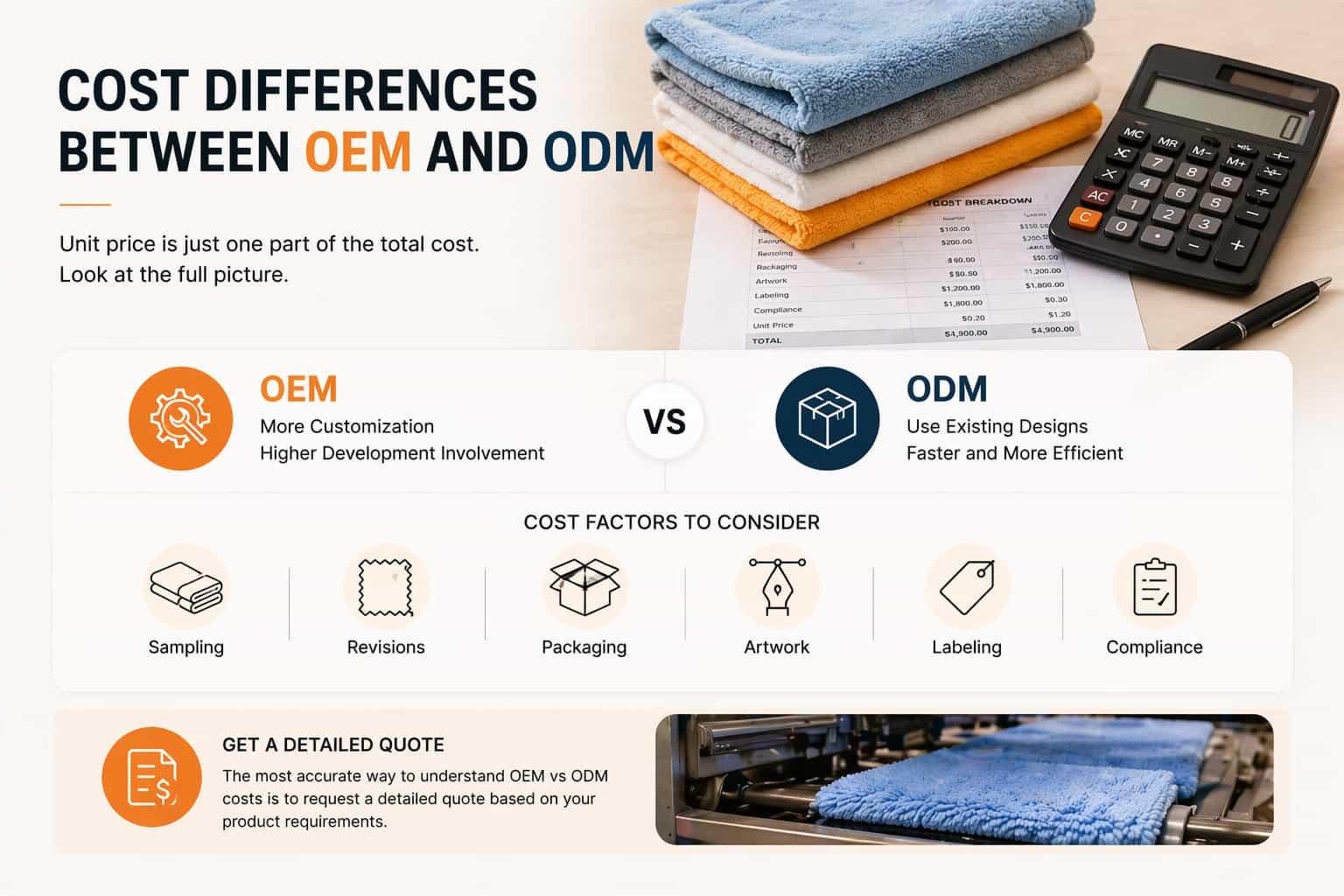
Cost Differences Between OEM and ODM
If you’re starting something like an Amazon store, chances are you don’t have a full R&D setup working around the clock. And that’s okay. This is exactly where ODM helps, since it allows you to work with existing product structures without going through extensive development.
However, the real cost should not be judged only on unit price. It should include sampling, revisions, packaging, artwork, labeling, and compliance requirements. You can request a detailed quote from a trusted microfiber towel manufacturer. They will give you a much clearer picture based on your product requirements.
Lead Time Differences Buyers Should Consider
Traditionally, OEM tends to take a bit more time because of the back and forth between design, sampling, testing, confirmations, and approvals. You are building the product brick by brick, and naturally, the process is more involved.
With ODM, the company already has a design and material ready, so the overall product is more or less established. In most cases, they already have something similar ready to send you as a sample, and you are only making minor tweaks to fit your brand.
Risks Buyers Should Watch Out For
When you choose private label, it can feel like control, but it’s mostly packaging. Boxes, pouches, inserts, barcodes, carton labels, all of that matters, especially for Amazon sellers, retail company, or DTC. But it’s just the wrapper. The real product still comes from either OEM or ODM.
Where it gets serious is compliance and execution. Things like fiber labels, country of origin, and even claims like “antibacterial” are regulated under FTC textile labeling guidelines. If you ignore this, you are not just risking delays; you are putting your entire supply chain at risk.
So, regardless of whether you choose private label or work toward exact specifications for brand differentiation at a competitive price, skipping these details will lead to problems.
- Not being clear on who owns the product specs
- Expecting bulk microfiber cloths to match samples without proper QC
- Thinking ODM can be customized more than it actually can
- Ignoring packaging and labeling rules for your market
- Choosing OEM without enough planning or volume
- Choosing ODM when your brand needs differentiation
At this stage, the model matters less than the microfiber cleaning products manufacturer. You want someone who understands QC, export requirements, customization, and can keep production consistent. That’s what actually keeps things running smoothly.
How to Decide Between OEM and ODM
At this point, it really comes down to what your business needs right now. Ask yourself:
- Do I need to create unique product or a faster launch?
- Do I already have brand specifications or base design?
- Is packaging important for my sales channel?
- Am I testing demand or scaling?
- Do I need quality control or speed?
- What is my real budget including development and packaging?
If you’re just starting your own brand name, especially on Amazon or DTC, it usually makes sense to go with ODM or lean towards a private label cleaning cloths line. Keep your SKUs low. Focus on testing demand rather than overbuilding the product. If you’re in performance-driven categories than OEM is the better route to consider.
As you start scaling into retail or distribution, a mix works best. You can choose OEM-backed private label microfiber towels. You will have control of the product design while keeping packaging and supply consistent. That’s also where OEM really starts to show its value, plus its real potential.
How Manywell Supports OEM and ODM Microfiber Cleaning Products
Choosing between OEM cleaning products and ODM cleaning products for your business model is only part of the decision. The bigger factor is who you choose to execute it. At ManyWell, we combine experience, scale, and consistency, prioritizing customer satisfaction with every delivery.
With over 18 years of experience in the microfiber market and manufacturing, we have built our process around one clear goal: making cleaning products that actually perform as expected. Instead of focusing only on volume, the emphasis is on material quality and careful control at each stage of production.
This becomes especially important in OEM projects. Small inconsistencies in GSM, weave, or finishing can affect the final product and limit your ability to create unique products. That is why we support buyers in making informed decisions, whether they choose OEM, ODM, or a hybrid approach that balances customization with efficiency.
Request a free quote today, and get a custom solution for your exact microfiber product requirements.
Final Thoughts
Once you’ve figured out which manufacturing model fits your stage, the next step is simple. Find a microfiber cloth supplier that can actually deliver on it. Even the right OEM or ODM setup won’t work if the factory behind it isn’t consistent with quality control and production.
A poor supplier choice can delay your launch. This affects the product quality and even exposes your product design. Before you move forward, it’s worth asking the right questions, such as how to choose a microfiber towel factory as a brand owner, so you always have complete control over what you’re selling.
FAQs
What is the difference between OEM and ODM?
OEM means clients can choose every single detail of the product, from how it is made to how it performs. The manufacturing is outsourced to a supplier. ODM is when clients select from an existing catalog of designs and only make small tweaks where possible, such as branding, color, or packaging.
Is OEM better than ODM for microfiber towels?
Not always. OEM is mostly preferred when you want to enter the market with a unique USP that is harder to copy, since you control how the product is built. ODM manufacturing, on the other hand, is preferred when your logo and branding are the main focus, and brand differentiation is less of a concern, so competition on similar products does not matter as much.
Is ODM cheaper than OEM?
Upfront cost of ODM is usually lower compared to OEM. However, in the long run, the profit margins between both models can vary greatly.
Can I add my logo with ODM products?
Yes, many manufacturers give the option to tweak custom packagings, logo, branding for ODM products according to the buyers.
Which option is better for new brands?
Newer brands tend to start with ODM as it saves them time and cost on development and they can test the waters before heading down the OEM route, depending on their business goals.